If you’ve been following AI development lately, you’ve probably heard whispers about something called Model Context Protocol, or MCP. Anthropic introduced it as an open standard for connecting AI models to external data sources—and it’s starting to show up in tools you might already use.
But what exactly is MCP, and why should you care? Let’s break it down in plain language.
What Model Context Protocol Actually Does
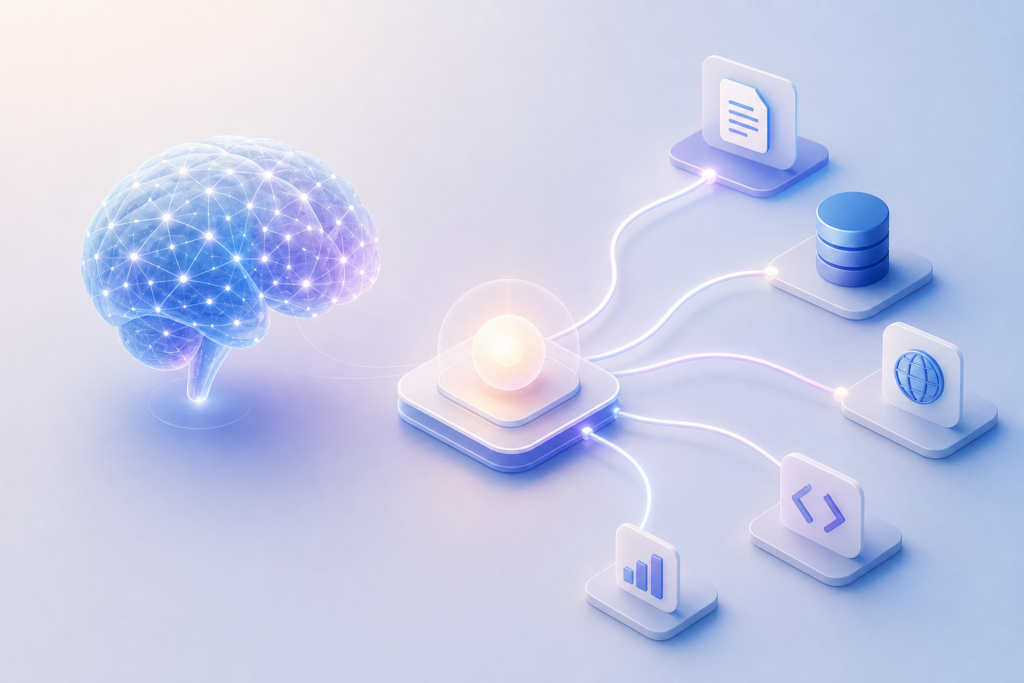
Model Context Protocol is a standardized way for AI models to access information outside their training data. Think of it as a universal adapter that lets Claude, ChatGPT, or any other AI assistant plug into your databases, files, APIs, or apps without needing custom code for each connection.
Before MCP, if you wanted an AI to access your company’s knowledge base or pull real-time data from an API, developers had to build custom integrations for each use case. Every tool, every model, every data source needed its own handshake. MCP standardizes that process.
Here’s a concrete example: with MCP, you could let Claude access your Google Drive, Slack workspace, and project management tool simultaneously—and the model would know how to query each one, pull the right data, and synthesize it into a single answer.
How MCP Differs From RAG
If you’re familiar with Retrieval-Augmented Generation (RAG), MCP might sound similar. Both let AI models access external information. But there’s a key difference.
RAG is a technique where you embed documents into a vector database, then retrieve relevant chunks to feed into the model’s context window. It’s powerful, but it requires preprocessing your data and works best with static documents.
MCP is more like a live connection protocol. It doesn’t require embedding or preprocessing. Instead, it lets the model query external systems in real time—databases, APIs, live documents, even command-line tools. If RAG is like giving the AI a well-organized filing cabinet, MCP is like giving it a phone line to call any department in your company.
Both have their place. RAG is great for large document libraries. MCP shines when you need fresh data, complex queries, or access to multiple live systems.
Where You’ll See MCP in Practice
MCP is still early, but it’s already being adopted. Anthropic’s Claude desktop app supports MCP servers, meaning you can configure Claude to access local files, databases, or APIs directly from your machine.
Developers are building MCP servers for popular tools—GitHub, Notion, Postgres, Slack, and more. Once connected, you can ask Claude to pull a code snippet from your repo, summarize a Notion page, or query a database—all in one conversation.
For non-developers, the practical impact will come when the tools you already use start offering MCP support out of the box. Imagine asking your AI assistant a question and having it automatically check your email, calendar, and project tracker without you lifting a finger.
Why This Protocol Matters
MCP is significant because it’s open and model-agnostic. Anthropic released it as a standard anyone can adopt, not a proprietary feature locked to Claude. That means OpenAI, Google, or any other AI company could implement MCP in their models.
If MCP gains traction, it could become the USB-C of AI integrations—one protocol, many uses, no vendor lock-in. That’s good for users, good for developers, and good for the ecosystem.
It also shifts AI assistants from static question-answering tools to dynamic agents that can act on live data. Instead of copying and pasting information into a chat window, you let the model reach out and grab what it needs.
MCP won’t replace every integration method, but it’s a meaningful step toward making AI assistants more connected, more useful, and less dependent on manual data shuttling.
Want to stay sharp on AI developments like this? Subscribe to the One Two Three AI newsletter—one useful AI idea in your inbox every day.