
You’ve probably noticed that when you ask ChatGPT or Claude about something recent, they sometimes admit they don’t know—or worse, confidently make something up. That’s because AI models are trained on data with a cutoff date. They don’t automatically know what happened yesterday, or what’s in your company’s internal documents.
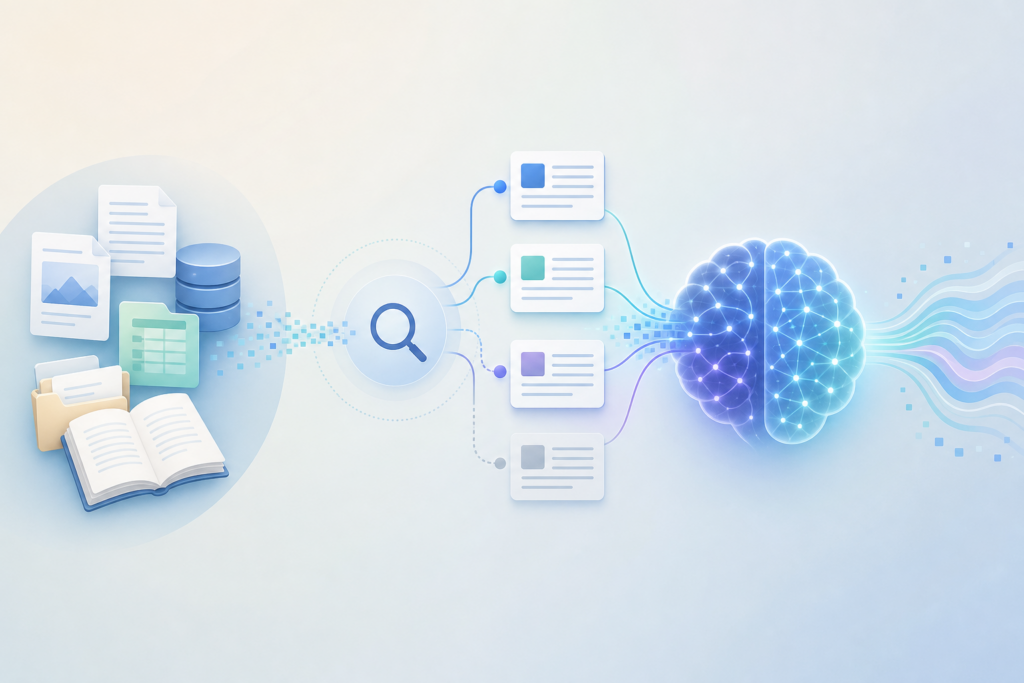
Retrieval-Augmented Generation, or RAG, solves this problem. It’s a technique that lets AI models search external sources—like databases, documents, or the web—and pull in relevant information before generating an answer. Instead of relying solely on what they learned during training, RAG-powered systems can access fresh, specific data in real time.
It’s become one of the most practical ways to make AI useful for real-world tasks, from customer support to research to internal knowledge bases.
How RAG Actually Works
Here’s the basic flow: when you ask a question, the system first searches a knowledge base or document collection for relevant information. It retrieves the most useful chunks—usually a few paragraphs or sections—and then feeds those into the AI model along with your original question.
The model reads the retrieved content and uses it to craft an answer. Instead of generating a response from memory alone, it’s working with specific, up-to-date source material.
For example, if you ask a RAG-powered chatbot about your company’s vacation policy, it doesn’t guess based on general HR knowledge. It searches your employee handbook, pulls the relevant section, and answers based on your actual policy document.
Why RAG Beats Fine-Tuning for Most Use Cases
You might wonder why not just fine-tune a model on your own data instead. Fine-tuning can work, but it has downsides: it’s expensive, it requires technical expertise, and the model still won’t know about information added after training. Every time your data changes, you’d need to retrain.
RAG is more flexible. Update your documents, and the system instantly has access to the new information. No retraining required. It’s also more transparent—you can see exactly which sources the model used to generate an answer, making it easier to verify accuracy and catch mistakes.
RAG is especially useful when you need the model to work with private data, like internal memos, customer records, or proprietary research. You keep control of your documents and don’t need to send them off for training.
Where You’re Already Using RAG
RAG isn’t some distant future technology—it’s already built into tools you might use daily. ChatGPT’s web browsing feature is a form of RAG: it searches the internet, retrieves relevant pages, and uses them to answer your question. Perplexity AI is built entirely around this approach, citing sources as it generates answers.
Many enterprise AI tools use RAG to let employees ask questions about company knowledge bases. Customer support chatbots use it to pull answers from help documentation. Legal and medical AI tools use RAG to reference case law or research papers.
If you’ve ever uploaded a PDF to ChatGPT or Claude and asked questions about it, you’ve used a simple version of RAG. The model retrieves relevant sections from your document and uses them to respond.
The Limits of RAG
RAG isn’t perfect. The quality of answers depends heavily on the quality of the retrieval step. If the system pulls irrelevant or outdated documents, the model will generate a bad answer—even if it’s technically working as designed.
RAG also adds complexity and latency. Searching a large document collection takes time, and the model needs to process both your question and the retrieved content. For simple questions that don’t require outside information, plain models are often faster and cheaper.
And RAG doesn’t eliminate hallucinations entirely. Models can still misinterpret retrieved content or fill in gaps with plausible-sounding nonsense. The difference is that with RAG, you at least have source material to check against.
Still, for most practical applications—especially those involving proprietary or rapidly changing information—RAG has become the go-to approach. It’s why so many AI tools now let you connect your own documents, databases, or knowledge bases.
Want to stay sharp on AI techniques that actually matter? Subscribe to the One Two Three AI newsletter and get one useful AI idea in your inbox every day.